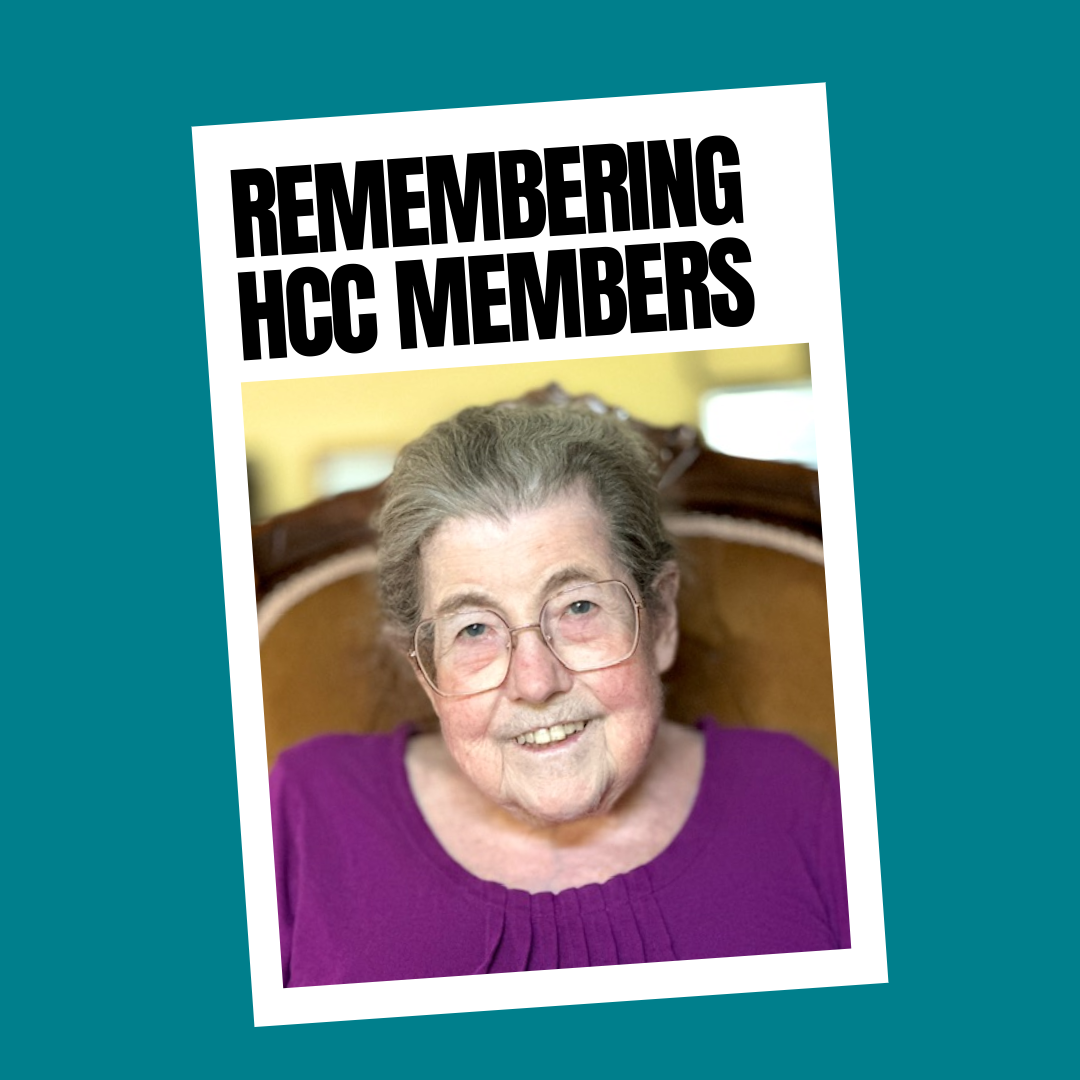
As we prepared for this academic year, we remembered Janet Seargeant, whom we sadly lost earlier this year. In her memory, we have named one of our Diploma cohorts after her. Janet first became involved with Highgate Counselling Centre in 1966 when she was a young trainee GP. She wanted to learn more about counselling and what she learnt then led her to a career in psychiatry. It was this curiosity, passion and energy that Janet brought to multiple roles over the decades she was involved in the work of HCC. She was an inspiration and calming force who carried such a great deal of experience with unfaltering humility. Janet generously gave an interview to our internal Newsletter, and we felt that her reflections deserved to be shared with a wider audience. With the kind permission of her family, we are therefore pleased to share the interview with you.
In Conversation with Dr Janet Muriel Seargeant, HCC’s Trustee
Tell us about your background?
Throughout my life I have been connected to the local area of Highgate and Muswell Hill. I grew up in Finchley and my father was a GP in Muswell Hill. I went to the Royal Free Royal School of Medicine, which is now combined with UCL, and qualified as a doctor in 1967. It was also the year I got married.
Back then the GP training was much shorter. After my preregistration house jobs I spent a year as a GP trainee assistant in Southgate after which I took an eight year break from work to bring up my three children. When my children were still young I worked one evening a week in a local family planning clinic.
What led you to work in the field of psychiatry?
This is where my connection with HCC comes in – my friend and I contacted HCC in 1966, asking if we could attend and observe the counselling training offered by HCC, as we believed it would benefit our work as GPs. The course director at the time, Dr Henrietta Meyer , a Psychotherapist, allowed us to join the course as ‘observers’, meaning, we were not allowed to contribute. This didn’t last very long .
The counselling training at the time was very different to what it is now. It lasted only three months, and was based on the book by Rev. William Kyle ( the founder of Highgate Counselling Centre) ‘Healing through Counselling’. HCC was different too, much less organised and run by volunteers.
The counselling course at HCC made me so interested in psychological matters that I decided that I wanted to work in psychiatry. I came across an article in the British Medical Journal written by a consultant psychiatrist who set up a department in Goodmayes Hospital in Ilford, employing women who had children and wanted to work part time only. I applied, was accepted and started my psychiatric training there. However, it was a long commute, and so when a training opportunity came up at Friern Hospital ( formerly known as Colney Hatch Lane Asylum) I applied there.
‘Colney Hatch’, was well known, even in literature, as one of the big Victorian mental hospitals.
It opened with much fanfare in the Great Exhibition year of 1851, as the largest and most modern hospital in Europe, with an objective of providing a humane place for treating mental health problems. At that time there was a farm and communal gardens, where patients could rest and work, providing self sufficiency.
Many people will have seen inside the Friern hospital without knowing it. For example, Britannia Hospital movie was shot there in 1981.
I vividly remember Friern’s most famous feature, a corridor extending over a third of a mile, ‘the longest in Europe’ as we were told. It was used in the ‘Alice in the Wonderland’ movie, for the scene when she disappears in a rabbit hole.
Visiting there as a medical student had felt strange and at that time I felt that I would never work in a place like this. I remember the eerie atmosphere and countless locked doors, and the feeling of being ‘locked in’.
Throughout my training there, I moved through different departments,, and then took my MRCPsych. exam in 1983, becoming an Associate Specialist, and then a Consultant Psychiatrist.
When the hospital closed in 1993, part of it was moved to St Ann’s in Tottenham, part to the Royal Free and part to the Whittington. The building and grounds were sold to developers, and the building was converted into luxury flats called Princess Park Manor.
A lot of research was done on the patients from Friern, which showed that many of them who were ‘stuck there’ for years, could have easily lived within the community instead. Many of those patients were moved to purposely built hostels, after the hospital closed down.
I remember a documentary that was made about it, both patients and new residents of the luxury flats were interviewed. I thought, watching it, that some of those who moved out sounded a lot healthier than those who moved in.
After leaving Friern I became a General Adult Psychiatrist at St Anns treating adults from 18 to 65. After that I worked a bit more in the community and did some management too. I retired from a full time work at 65 in 2009. We went travelling for a bit, and then I came back to work for a couple of days a week to cover for someone. I finished working completely in 2012.
What brought you to being a Trustee at HCC?
In a way HCC was there before I went into psychiatry and was there again, when I retired.
The connection to HCC went on, from when I did the counselling training, and then, after a long break during which I was working, I joined the HCC management council. This was before HCC became a trust. I was invited by then chair, Andrew Elder. One of my roles was to provide HCC with psychiatric advice when needed. This however happened fairly rarely. Once or twice I actually saw a person for them. In other words, I served as a bit of a back up. I would also, when required, put clients in touch with the right people within the local services.
After I retired I continued my connection with HCC as a trustee.
I feel very closely connected to HCC, having been here for so long and feeling grateful – HCC helped my interest in psychiatry. I feel that I owe that to HCC.
In your opinion, what is a role of a trustee in an organisation like HCC?
There is the statutory role, trustees have responsibility for the smooth running of the charity. Of course, it is all down to the director, but we work closely together. The money bit is the one I’m least interested in. However, we have very robust financial subcommittee (Nick and Lindsey) looking after that. In other words, we are there to look at different ideas and decide on what can and cannot happen, plus dealing with any problems, which happens very rarely nowadays.
Interview first published in our internal newsletter, April 2024